Fire Watch Tower – Sharjah International Airport
Project Overview
CDE Engineering Services was appointed by Sharjah Airport Authority to carry out a detailed structural condition assessment and evaluate the feasibility of rehabilitation and vertical expansion of the existing Fire Watch Tower located at Sharjah International Airport.
The structure is an approximately 50-year-old reinforced concrete building comprising slabs, beams, columns, and foundations. The objective of the project was to assess the current structural condition, identify deterioration mechanisms, and determine whether the structure could safely accommodate an additional office floor.
Client
Sharjah Airport Authority
Location
Sharjah, UAE
Client Challenge
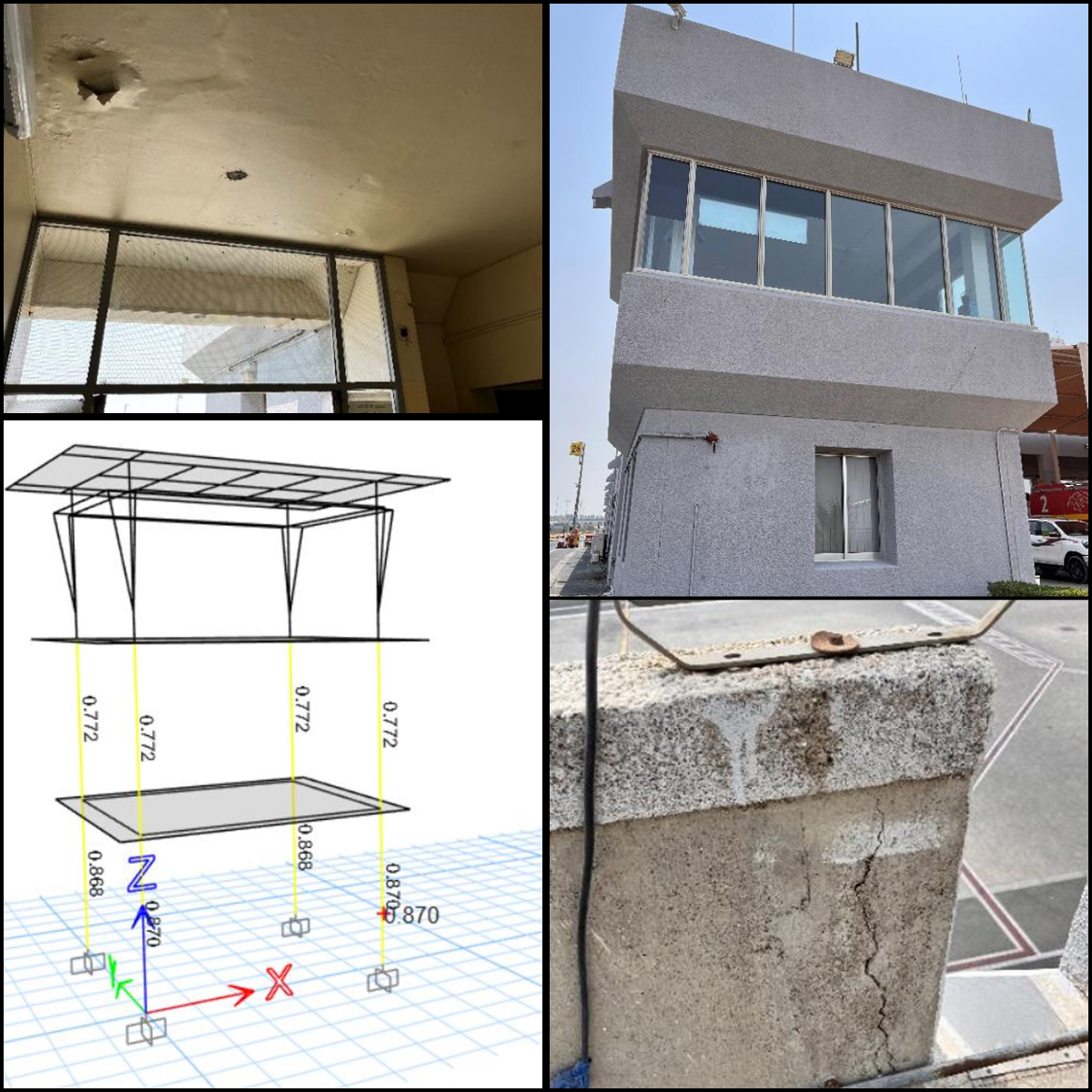
The tower exhibited visible signs of deterioration, particularly in structural elements exposed to environmental conditions and moisture. Given the age of the structure and its operational importance within the airport, there were concerns regarding durability, structural integrity, and long-term performance.
In addition, the client intended to add an additional floor, requiring a thorough evaluation of the structure’s capacity to safely support increased loading.
Scope of Work
Our Approach
CDE carried out a comprehensive investigation combining field testing, material evaluation, and structural assessment.
Visual inspections and hammer sounding were conducted to identify surface defects, delamination, and areas of distress. Advanced testing methods, including GPR scanning, core sampling, compressive strength testing, and chemical analysis, were used to evaluate material properties and durability parameters.
The assessment focused on identifying deterioration mechanisms, particularly those related to environmental exposure, moisture ingress, and corrosion. Structural evaluation was performed to determine the ability of the existing system to support additional loads from the proposed extension.
Key Findings
The structure was generally found to be structurally sound, with the primary concerns related to localized deterioration rather than global structural instability.
Significant deterioration was observed in grade-level tie beams and slab soffits, where concrete delamination and damage were evident. These issues were primarily attributed to chloride-induced corrosion resulting from prolonged exposure to moisture and environmental conditions.
Material testing confirmed localized degradation, particularly in areas with inadequate protection against moisture ingress.
The superstructure, including beams, slabs, and columns, was found to be capable of supporting the proposed additional floor. However, further verification of foundation capacity was recommended based on bearing capacity data.
Solutions & Recommendations
CDE proposed targeted rehabilitation measures to address deterioration and enhance long-term durability.
These included removal of delaminated concrete, replacement of corroded reinforcement, and application of protective repair systems. Installation of embedded galvanic anodes was recommended to provide long-term corrosion protection.
Protective coatings were also advised to mitigate future carbonation and environmental effects.
A periodic inspection and maintenance plan was recommended, with reassessment intervals of approximately five years to monitor structural condition and durability performance.
Further evaluation of foundation capacity was recommended prior to implementation of the proposed vertical extension.
Outcome
The study provided the client with a clear understanding of the structural condition and feasibility of extending the existing structure.
Through detailed investigation and engineering evaluation, CDE confirmed that the tower could safely accommodate the proposed additional floor, subject to verification of foundation capacity.
The recommended rehabilitation measures ensure improved durability, enhanced corrosion protection, and long-term structural performance.